Tether deepens AI bet, backs Italian firm’s humanoid robots

cointelegraphPublished on 2025-12-09Last updated on 2025-12-09

Abstract

Tether, the stablecoin issuer, has participated in a €70 million ($81 million) funding round for Italian AI startup Generative Bionics. The investment, led by CDP Venture Capital, supports the development of advanced humanoid robots designed for industrial performance and human-centric interaction. Tether's capital will help accelerate the development of Physical AI systems, the construction of a production facility, and integration into the broader robotics ecosystem. Generative Bionics, a spinoff from the Italian Institute of Technology, focuses on building robots with real-world AI capabilities for factory use. This investment aligns with Tether’s broader strategy of supporting emerging technologies that expand human potential and reduce reliance on centralized systems. The firm has been active in AI investments, including a potential $1.15 billion investment in German robotics startup Neura and initiatives in brain-computer interfaces and large-scale AI compute networks.

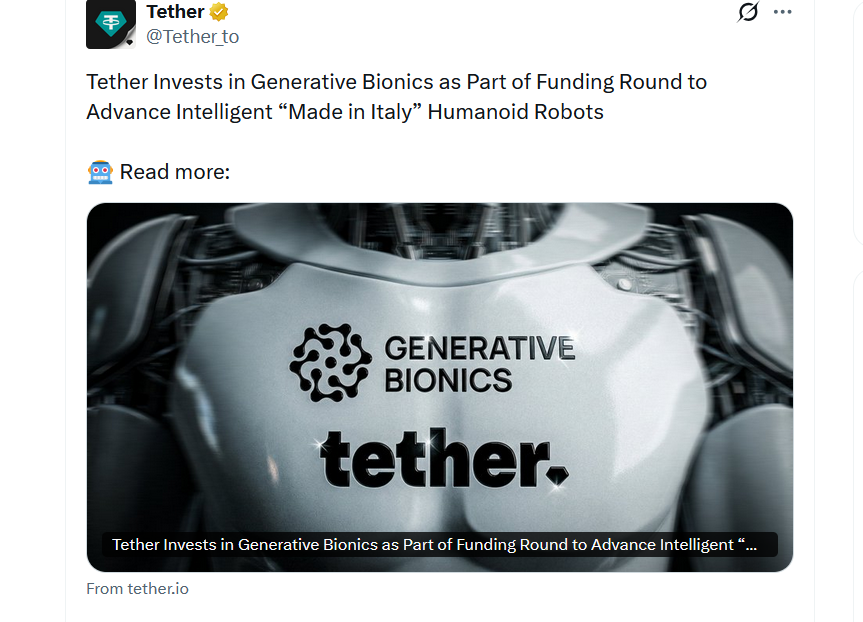
Stablecoin giant Tether has announced it is one of the backers of an $81 million funding round for an Italian artificial intelligence startup aiming to build advanced humanoid robots.

The 70 million euro funding round for startup Generative Bionics was led by the AI fund of CDP Venture Capital, with participation from Tether, AMD Ventures, Duferco, Eni Next and RoboIT.

In an announcement on Monday, Tether said it provided capital to support the development of advanced humanoid robots, “built for industrial scale performance” and “human-centric interaction.”

“Tether’s investment will support the development of Physical AI systems and edge AI solutions, and accelerate the industrial validation of the company’s humanoid platform, the development of its first production facility, and its integration in the broader robotics ecosystem,” Tether said.

Generative Bionics is an AI startup and research spinoff from the Italian Institute of Technology. Its focus is on building humanoid robots with “real-world physical AI capabilities” such as industrial usability in factory production lines.

“Tether’s support for Generative Bionics builds on its broader strategy to back emerging technologies that expand human potential while reducing reliance on centralized systems overseen by Big Tech,” Tether said.
Source: Tether

Related: Tether's USDt awarded key regulatory status in Abu Dhabi

According to Tether, the firm focuses on five areas of investment. These include: finance, power, data, education and evolution, with AI investments such as these falling under the category of evolution.

With a healthy balance sheet in 2025, the firm has made a series of investments across multiple sectors. In terms of AI, it was reported in mid-November that the firm was considering a hefty $1.15 billion investment in German AI robotics startup Neura.

In the announcement, Tether also highlighted some other AI plays it has supported.

“This includes investments in brain-computer interfaces via Blackrock Neurotech and recent AI initiatives such as Tether’s collaboration with Northern Data and Rumble to deploy a 20,000-GPU global compute network for open, privacy-preserving AI development,” Tether said.

Magazine: Opinion: Stablecoins will see explosive growth in 2025 as world embraces asset class



Related Reads

Tether's "Favorite Son" STABLE Crashes? Plunges 60% on First Day, Whale Jumping the Queue + No CEX Listing Sparks Trust Panic

Stable, a new Layer 1 blockchain heavily backed by Tether and Bitfinex, launched its mainnet and STABLE token on December 8. Despite significant pre-launch deposits totalling over $1.3 billion and strong market interest, the token’s first-day performance was highly disappointing. It opened around $0.036, briefly rose to nearly $0.046, then plummeted over 60% to a low of $0.015. Its fully diluted valuation (FDV) fell to $1.7 billion amid thin liquidity. The token’s not yet listed on major centralized exchanges like Binance or Coinbase, limiting its accessibility. The launch wass marred by controversy after a whale deposited hundreds of millions of USDT before the official start time, raising concerns about fairness and possible insider trading. This damaged trust in a project whose core narrative is transparency and reliability. Stable is designed as a stablecoin-focused chain with USDT as the native gas fee, aiming for a near gas-less user experience. It uses a custom DPoS consensus mechanism and is EVM-compatible. However, its tokenomics have raised concerns: STABLE tokens are used only for governance and staking, not fee payment, and 50% of the total 100 billion supply is allocated to the team, investors, and advisors with a one-year cliff. The project faces intense competition from established chains like Polygon, Tron, and Solana, as well as emerging stablecoin-specific L1s like Circle’s Arc and Paradigm-backed Tempo. Its success hinges on rapid execution, ecosystem development, and enterprise adoption planned for late 2025 to mid-2026. Early missteps and a lack of trust have cast doubt on its ability to compete.

marsbit32m ago

Tether's "Favorite Son" STABLE Crashes? Plunges 60% on First Day, Whale Jumping the Queue + No CEX Listing Sparks Trust Panic

marsbit32m ago

Trading

Spot
Futures
活动图片